
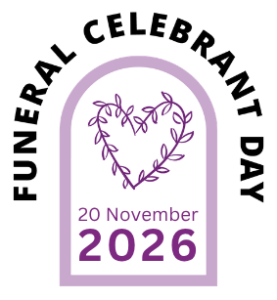
Friday 20 November 2026 is World Funeral Celebrant Day, an opportunity for funeral celebrants across the country and beyond to celebrate the work we do, raise awareness of the choices available to families, and perhaps encourage a few conversations about a subject we’re not always terribly comfortable discussing – death.
There, I’ve said it! It’s something that will happen to every one of us, yet we can be remarkably reluctant to talk about it.
While I don’t expect everyone to suddenly start discussing their funeral arrangements over breakfast, I do think there’s an enormous amount to be gained from understanding the choices we have.
So, in the spirit of World Funeral Celebrant Day, I thought I’d share a little about what I do, why I love doing it and why I believe a meaningful farewell can make such a difference.
What does a Humanist funeral celebrant do?
When I tell people I’m a Humanist funeral celebrant, I sometimes get the impression that they imagine I turn up at the crematorium, read a few words, press the appropriate buttons, and head home.
The ceremony itself is just one small, albeit very important, part of my work.
Long before the day of the funeral, I spend time with the family, listening to their memories, learning about the person who has died and discovering what made them who they were. And what wonderful conversations those can be.
We talk about childhoods, careers, friendships, relationships, achievements, adventures and all those little habits and peculiarities that make someone unmistakably themselves. Sometimes there are tears; often there is laughter.
I take those memories and create a ceremony that tells a person’s story with honesty, warmth, dignity and, where appropriate, humour – something that makes the people attending think, “Yes, that was them.”
Every life is extraordinary in its own way
One of the things I’ve learned since becoming a Humanist celebrant in 2018 is that you don’t have to be famous, wealthy or have achieved something remarkable to have lived a life worth celebrating.
In fact, some of the most moving stories I’ve heard have been about the simplest things:
-
The dad who always turned up when someone needed help.
-
The mum whose kitchen was the centre of family life.
-
The friend who could make everyone laugh, even on the worst of days.
-
The grandparent who never forgot a birthday.
-
The person who quietly made life better for those around them, without ever expecting recognition.
These are the things people remember and they’re often the things that matter most.
A funeral isn’t simply about acknowledging that someone has died. It’s about recognising that they lived and celebrating that life. That, to me, is at the heart of being a funeral celebrant.
A meaningful ceremony makes room for the whole person and the whole range of emotions that come with remembering them. There is no such thing as a one-size-fits-all funeral.
The freedom to create a meaningful farewell
For many years, people tended to assume that funerals had to follow a fairly standard format: a particular building, a particular order of service, certain readings, perhaps a hymn or two, and a fairly limited amount of time.
But increasingly, families are discovering that they have far more choice than they might have realised.
A funeral can be formal or informal, traditional or unconventional. It can include favourite music, poetry, family contributions, photographs, symbolic gestures and stories that might never find their way into a conventional service, and it doesn’t necessarily have to take place in a crematorium or traditional chapel.
A meaningful celebration of life might be held in a garden, a village hall, a favourite pub, a woodland setting or somewhere else that holds special significance.
What matters is that it feels right for the person being remembered and for those who are saying goodbye.
As a Humanist celebrant, I create non-religious ceremonies that reflect people’s lives, values, relationships and wishes.
There’s no prescribed script and no requirement to include traditions that don’t feel meaningful. Instead, we have the freedom to create something personal, thoughtful and authentic.
Direct cremation and a separate celebration of life
This year’s World Funeral Celebrant Day is highlighting an important subject: direct cremation and the opportunities for families to arrange a separate celebration of life.
Direct cremation means that the cremation takes place without a funeral service at the crematorium, usually without mourners attending.
For some families, it’s a practical and affordable choice. For others, it reflects the wishes of someone who didn’t want a traditional funeral.
But there’s a misconception that choosing direct cremation means giving up the opportunity to gather, remember and say goodbye. That simply isn’t the case.
Direct cremation doesn’t have to mean no celebration. A direct cremation can be followed (or preceded) by a personal celebration of life, held at a time and place that suits the family.
Imagine gathering in someone’s favourite pub, where friends and relatives can share stories over a drink, or meeting in a garden filled with flowers they loved.
Perhaps a family would prefer a relaxed afternoon with photographs, favourite music, readings, memories and plenty of tea and cake?
Without the usual crematorium time restrictions, there can be more freedom to decide what the occasion looks and feels like.
Of course, this approach won’t suit everyone. Some people find great comfort in a traditional funeral, with the coffin present and a familiar structure to the ceremony. Others may prefer a very private farewell, or no gathering at all.
There is no single correct choice, but I feel strongly that people should know what their options are.
Choosing a direct cremation doesn’t mean choosing not to remember, and a celebration of life can be every bit as meaningful when it’s held separately from the cremation.
The importance of talking about death
As a Humanist, I believe this is the one life we have, and perhaps that’s why I feel so strongly about making the most of it, valuing our relationships and recognising the importance of the memories we create.
Talking about death doesn’t mean we’re being morbid. It can mean talking about what matters to us, how we’d like to be remembered and what sort of farewell would feel right.
Whether we’d prefer a traditional funeral, a natural burial, a direct cremation followed by a celebration of life, or something completely different, these conversations can be surprisingly positive.
They give us an opportunity to share stories, express wishes and perhaps discover things about the people we love that we never knew.
And when the time comes, they can spare families the additional worry of trying to guess what someone would have wanted.
I know from my own personal experience how valuable those conversations can be.
They aren’t really conversations about death; they’re conversations about life, love, relationships and the things that make us who we are.
Celebrating World Funeral Celebrant Day
So, on World Funeral Celebrant Day, I’d like to acknowledge my fellow celebrants, whatever their approach or beliefs.
We may work in different ways, but we share the responsibility of helping people navigate some of life’s most difficult moments.
And I’d particularly like to thank the families who have placed their trust in me over the years.
It’s a privilege to be invited into their lives, to hear their stories and to help create a farewell that feels right for them.
I still find myself moved by the extraordinary variety of human lives and the remarkable capacity people have for love, resilience, kindness and laughter.
No two people are the same, and no two farewells should be either.
Because every life has a story worth telling, and every family deserves the opportunity to remember that life in a way that feels meaningful to them.
If you’re considering a Humanist funeral, planning ahead for your own farewell, or wondering about direct cremation and a separate celebration of life, I’m always happy to have a friendly, no-obligation conversation.
0 Comments